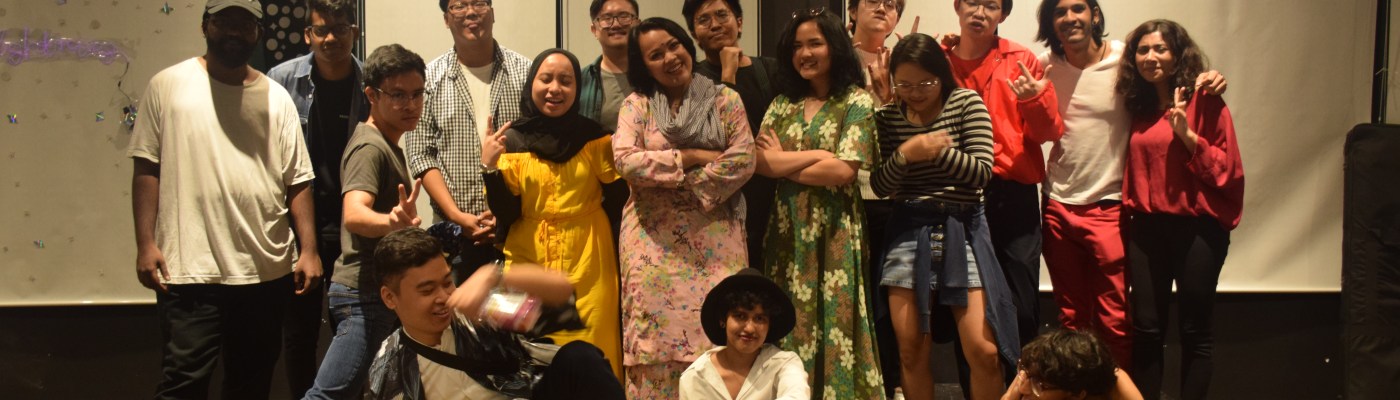
The Literature and Drama “Society’s Spoken Word Night: Dreams & Nightmares, 2019”
This year marks the second year running for the Spoken Word Night. It’s a poetry event where students and lecturers alike perform their own poems. However, this year, the event has been revved up to include, alongside students, guest performances: Ms Sheena, Kimchi Lai and Leon Sapphire and his band. This phenomenal event was paired with three workshops, led by Ms Sheena to explore, refine, build and create your own poetry, which would then be performed on the Night itself.
This post will account my own personal experience from attending the 3 Workshops for this event.
For this year, the event was focused on multi-media poetry!
What is multi-media poetry?
Multi-media refers to a combination of media such as images, projections, music and visual aesthetics such as dance. I like to think of it as something that appeals to the five senses:
sight, hearing, smell, taste and touch. Multi-media poetry therefore incorporates media with Spoken Word poetry. With such an extensive rang of possibilities, Sheena helped break down multi-media spoken word into two segments: voice and visuals.
Sheena used the metaphor that voices and sounds should be seen as colour, a sort of
synesthesia, where the different shades and vibrancy can reflect your mood and emotions. When someone speaks, it is their voice that is the craft that provokes a play of images in the audience’s mind. That is the powerful essence of your voice.
Visuals can range from anything media related, like moving images and videos. Sheena emphasised on the use of physicality as a key visual element to Spoken Word. It is how you use your body, your hand gestures, your eyes – depending on how you use it, it can truly change or add an entirely different atmosphere to your performance.
WORKSHOP 1:
Being a rather closeted poet, I’ve never shown my poetry let alone done any spoken word before. I was rather nervous and anxious, but Sheena warmed up everyone with her welcoming approach to coaching. It didn’t matter if you were a beginner or had years of experience in Spoken Word, all you had to have was a drive to improve and an appreciation for poetry.
We ditched the tables, and the organised chairs of the lecture room, and sat on the floor in a circle. Okay, so we’re all comfortable now, I thought. But then, Sheena asked us to perform our own poetry.
I didn’t bring my own poems with me. Did I forget to bring it? Yes. But also, I felt that poetry, and certainly my poetry, is very personal, and it’s hard to share something so private. Sheena wanted to study our performance to figure out our unique styles and characteristics when we perform, and what we should build on. So, I performed a section from one of my favourite poems – Prayer Before Birth by Louis MacNeice.
Through a collection of other people’s and Sheena’s comments about my style of delivery, it brought to my attention things I didn’t know I was doing. From my tone of voice, emotional expression, and clarity.
DREAMS AND NIGHTMARES
What are Dreams And Nightmares? Both found in the subconscious of your mind, are seen to be representative of the reality you’re facing. Dreams. In the workshop we explore these terms. Dreams were seen as a form of healing, an escape or a reinvention of a memory. They are pleasant. Nightmares were seen as horrors, demonic entities that tortured the mind. And then there was the area in-between being alseep and awake, between unconsciousness and reality, a liminal space where the boundaries were broke – the sleep paralysis. Your body unable to move, and your mind able to ‘see’ or hallucinate things you could have never imagined.
Sheena asked us to write briefly a dream or nightmare we had, and share it to the rest. I picked a nightmare:
“Looking through a window of a hospital door, I see a large room with — on a bed, in the centre. I don’t see her face, but it’s her, I know it is her. For some reason, I can’t seem to move closer or further away from her, but maybe I don’t want to either. The windows shifts and morphs, and from the swirling of glass and colours, — hands lurch towards me, and I wake.”
***names and pronouns may have been changed and removed.
From our passages, we were asked to select one word that describes the emotions we felt during the nightmare/dream, and a one word imagery. “Helpless” and “windows” were my two words. With them, we were tasked to write a 3 minute poem with these words in mind to bring to the next workshop.
In my next post, I cover the next two workshops! I show how the poem that sprouted from this exercise was made into a multi-media piece, and how I developed my own Spoken Word style of my performance
All photos, videos, gifs, podcasts and info-graphics used in this blog are self-produced unless credited otherwise.
 Behind the Curtain