LAD’s One Act Play Festival 2019
My one act play was a theatrical experimental piece I have always wanted to try, and this festival was the perfect platform to experiment and explore new forms and styles of performance.
If you’ve read my previous post, you might assume my play follows a typical structure or has a sense of realism. If you’ve watched my play, you’ll understand that my play is a little eccentric and unconventional. What do I mean by this? I’ll explain more in this post.
ABOUT THE TALE
For those who weren’t able to watch The Epic Tale of Prometheus, here’s a brief synopsis for you:
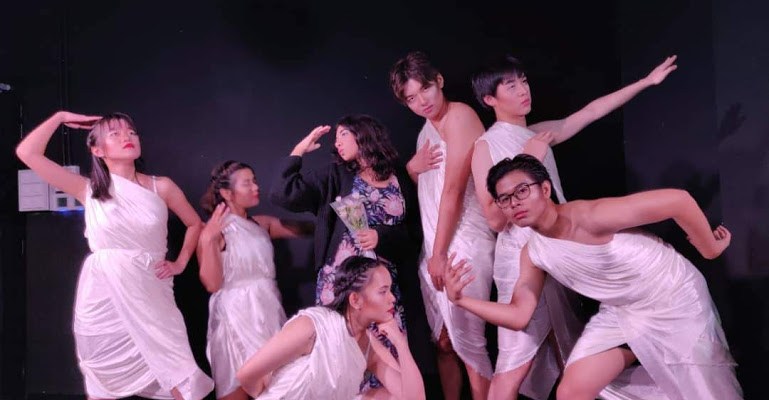
The meta-physical play is inspired by Ancient Greek Theatre. The Chorus tell the tale of Prometheus, a legend about a titan who stole fire from the Gods and gave them to humankind. However, soon the Chorus disputes over the story, and decide to tell a different legend entirely. Through movements, gestures and rhymes, the story of Orpheus is told. This comedic yet unconventional play engages with the audience to bring about a fit of hysterical laughter. whereby the chorus, a group of actors narrate and commented on the action of the play.
Throughout The Epic Tale of Prometheus, the characters would break from their Greek Chorus forms to not only comment on Orpheus’s tale, but also directly address to the audience their own personal opinions about it. My play was heavily depended on breaking the fourth wall of realism, and including and engaging with the audience’s reactions was part of the performance.
There was the main narrative; the story of Orpheus which was narrated as a poem, with rhymes and beats. This was performed in unison, and involved stylised movements and gestures. Then, there was the sub-narrative run alongside the main narrative, in which the Chorus’s true individual personalities emerged. Here, one chorus member expressed his reluctance to tell the tale.
She mentioned that this play was meant to be comedic, light-hearted and experimental. Just as the title promises, this play centres around the Greek mythology of Prometheus. Unlike the other plays we’ve seen, this play had a more lyrical approach to its lines. The cast were angels/divine beings retelling the story of Prometheus. They had to coordinate the sequences of the line, making it sing-song like. Along with the catchy lines, exaggerated actions and humorous facial expressions were also a major part of the play too. It conveyed just how light-hearted the play was made out to be.
UNMC IGNITE REVIEW
knowing your vision
It’s essential to understand the narrative and characters in order to envision what you want your play to be like.
In my case, I knew I wanted to create a play that was:
- An ensemble piece – focus on building unison in a group of actors rather than just specific characters.
- A physical theatre piece – focus on physicality and facial expressions to symbolise and represent something.
- A form of entertainment – with a comedic and light-hearted tone.
- Is about a less-known Greek mythology – the tale of Orpheus (not Prometheus, the title is a joke, a deliberate joke).
What is Physical theatre?
Physical theatre is a form of theatrical performance that emphasises on the use of physical movement, such as dance and mime, for expression. Movements, rather than words, could symbolise and create an entire setting or atmosphere.
I’ve always been fascinated with Physical Theatre. Being a lover of the more classical approaches to acting like Stanislavski and Brecht, it was only when I studied Drama and Theatre Studies for IGCSE and A Levels, did I really discover my love for Physical Theatre. Since I became a university student, I never had the chance to use this style of performance, and a part of me grew hungry to try it out again.
OAPF was the best place to try out something new.
staging
Breathing life into your script, in my opinion, is the most important stage in the directing process. It’s the process of selecting, designing, adapting to, or modifying the performance space for the play. For me, staging is when I plan out movement of characters on the stage, the set design, character’s exits and entrances. It works like a base, or a map, that gives you directions to building up your vision.
I went for something more minimal in terms of set design, and decided to just have the performance stage. The stage was too small, so to have a cast of six actors that remained on stage, and have them do large movements, would have been a safety risk as well. The safety of your cast is always ALWAYS important.
I don’t think having less set limited my piece in any form. My play placed more emphasis on body expression and movements – I wanted the audience to focus on that. However, that didn’t mean that I didn’t create metaphorical settings. I choreographed movements to symbolise different settings, like trees in a forest, or a boat in an ocean.
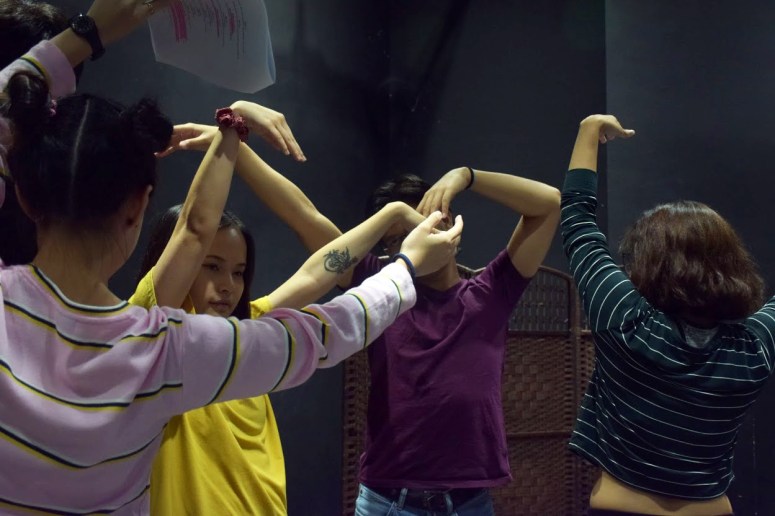
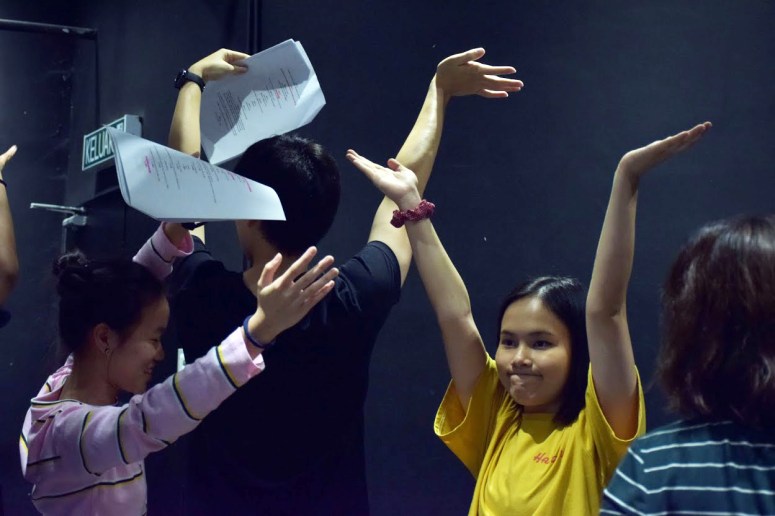
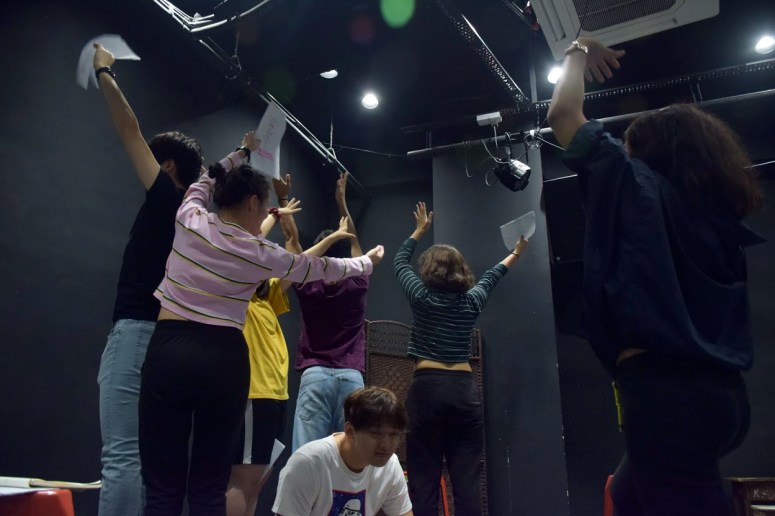
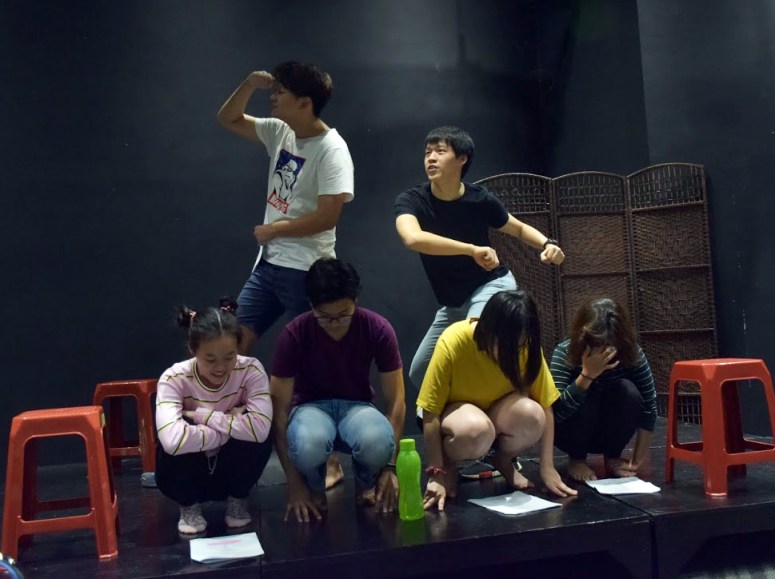
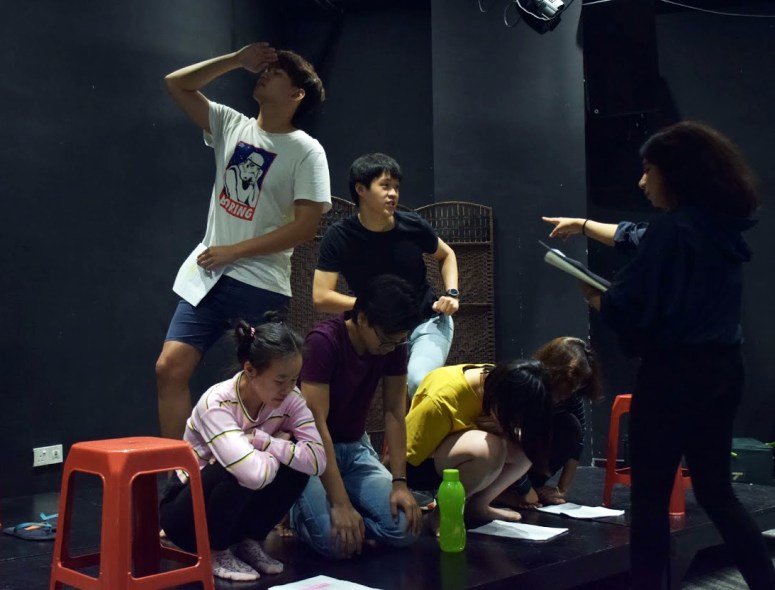
Before I started staging, I first drew inspiration from other physical theatre performances online. I was influenced by physical theatre and ensemble pieces, however I didn’t stick to this structure. The whole purpose of my piece was to subvert the traditional performances that people on campus are familiar with. In that respect, I also wanted to subvert any performance traditions.
By seeing what other people have done, you can challenge any assumptions you have about theatre that limits its endless possibilities. In-turn, this could stimulate your own creative abilities. You start wondering of all the different ways you could uniquely communicate meanings to your audience, and then slowly can come up with your own ideas.
There are three things you need when you think about staging: your script, paper and pen. Oh, and add on a glass of water, coffee and a huge scoop of time. I would dedicate hours, or a full day, to mark out the entire scripts’ staging and set. Yes, I did it all in one seating. I know, that sounds intense, and rather insane. I like to build up on an idea and vision, and for me, if I break up my staging periods, it can sometimes break the flow of events.
Others stage their play differently, but for me this entire process involved a lot of scribbles and stick-men doodles. My notes included cues from the script, and movements that corresponded to lines. I like to this of this as an intense creative period where I let my ideas run free. Of course, a few days later I return to the staging script and refined any ideas.
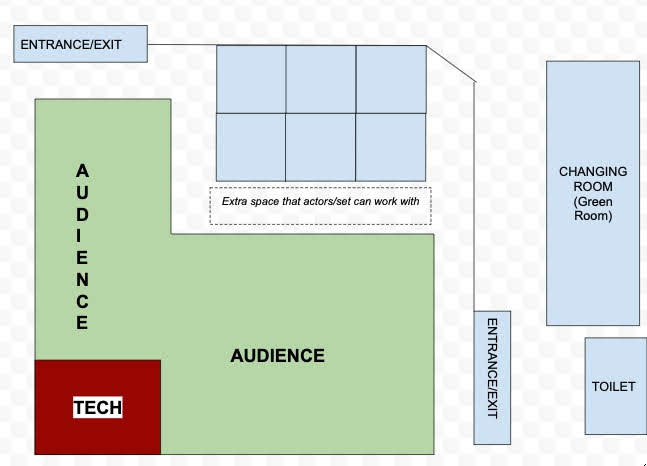
Be sure to know what you staging areas is. That way you can mark out movements on the stage, using terms like Centre Stage, Right Stage, Upper stage, etc. to be more specific in your movements. Also, be sure to start chronologically when you go through your script – work from Scene 1 to the end. That way, you can work on transitions from scenes as you go.
TECH, MAKEUP, HAIR AND COSTUMES:
A huge part of directing that some directors over-look is the production side to the play, which is an essential element that works together to towards your overall vision. The first thing a director should take into account is the Technical cues. Technical cues are signals for a change of lighting or sound effect that needs to be carried out at a specific time. For this, you will need a separate copy of the script that includes these cues. In this script, state before or after the line or movement, what the technical cue is.
Example 1.
Dylan: “But that’s impossible!” (Light turns red)
Joanna: “Is it?” (Light turns back to yellow wash)
Think of lights as an on-and-off thing. You need to state which area is lit, what colour, when there’s a change, or when the light turns off. The same goes with sound cues. The Drama Studio (F4LG07) has LED lights, that can be turned into coloured lights like orange, blue, red, yellow pink and many others.
Example 2.
Dylan: “But how could she?” (Light at right stage lights up, blue colour)
Joanna: (Blue light on right stage turns off, pink light on left stage lights up) “I didn’t think it was possible either!”
If you put the cue before the lines, the cue will signal that the lighting/sound change will only occur after the line is said. Vice versa if the cue is applied after the lines.
Again, I kept my cues simple, having the centre stage lighted with a light shade of pink throughout. I had considered a wash, which means all lights on, however I wanted something more concentrated, which would work almost like a spotlight on the actors, adding to the aspect that the Chorus are almost like divine beings.
I had done my own casts makeup, hair and costume. My entire cast, regardless of gender, wore shiny togas, makeup with heavy gold highlight and bronzing/contour, eyeliner and lipstick. I wanted to recreate Ancient Greek statues, and wanted my cast to look aesthetically striking. Remember, this is a visual element to your piece, and can really create the character’s mood, personality and condition.
If you’re finding it difficult to come up with Technical cues or Makeup, Hair and Costume, you can always approach the LADS committee, or ask the Head of Tech, Head of Hair and Makeup or Head of Costumes for help and for ideas. They are very willing and open to help out, so don’t be afraid to approach them 🙂
Like this post? Want to know more about how I specifically staged The Epic Tale of Prometheus? Or want to learn more about how to run rehearsals? Tune in to OAPF Part 2B: A Guide to Directing The Epic Tale of Prometheus for more information!
All photos, videos, gifs, podcasts and info-graphics used in this blog are self-produced unless credited otherwise.
 Behind the Curtain