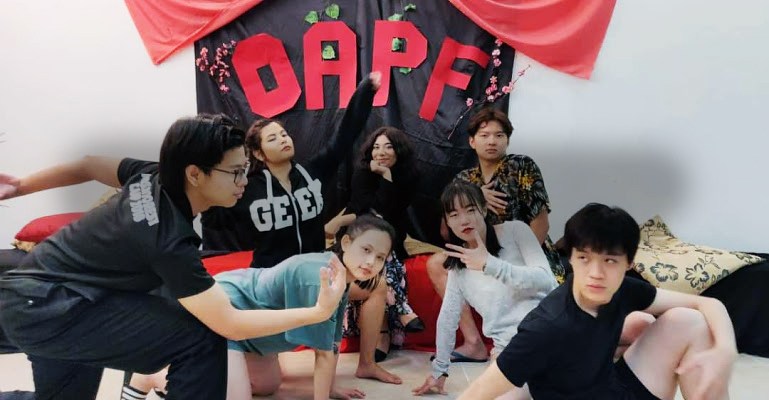
LAD’s One Act Play Festival 2019
One of the biggest events for the theatre department for LADS in Semester 2 is the One Act Play Festival.
Showcasing a series of multiple one act plays, the festival is a celebration of student-driven work, inclusive of both Undergraduate and Postgraduate students. Being the 4th year running, people from different faculties – from Engineering, Business, Psychology, English, SMLC (and more) – all come together to take part in script-writing, directing, acting and being part of the production crew.
This year, this 2 day festival has been transformed into 3 days to accommodate for 13 plays – marking this year as the largest festival for LADS to date!
For this semester, I took on the decision to write and direct my very own short play, called The Epic Tale of Prometheus. It’s a comedy that follows a Greek Chorus ensemble telling the story of Orpheus (yes, not Prometheus).
Therefore, this post will give you a brief guide and some handy tips on script-writing that I found useful when I was writing. Do note though, I am not the most experienced script-writer, and these tips are based on my experience in writing for this particular play.
Writing is, and always will be, something personal, and these tips might not work for everyone. Either way, I hope that you find it useful and a good starting point when you start writing your own scripts!
brainstorming IDEAS
Let me clear up any misunderstandings you might have – I did submit my script VERY LATE – as in the early mornings after the deadline. It’s difficult to create creativity on the spot, let alone write a script in a day – yikes!
How did I write ‘The Epic Tale of Prometheus?’
It’s a question I get asked a lot from audience members who watched my play. My response is always the same, and, I would say:
” I wrote the play a few hours before the submission deadline. It’s the result of my 3 am. brain and deliriousness. “
I had writer’s block, for quite a long time (and yes, that doesn’t just happen with me when writing assignments). Looking back now, I realise that I had placed unnecessary pressure on myself to create. I treated my first draft as the final draft, and was cautious in the way I wrote. I wanted to include everything, from politics, to romance, to social issue. But, you see, over-thinking the process of script-writing can really diminish your creative freedom.
So, I scrapped my depressive, overly symbolic piece and started afresh. Don’t worry, I’ll come back to my first idea one day.
Mind-mapping
Mind-mapping is a great way to kick-start your creative exploration. It’s an effective way of noting down information or exploring ideas in a form of a map. Think of it as a map, or a tree. The centre represents the main idea or thought, and the branches that come out from the centre are secondary thoughts you build on. You can use images, colours, symbols and different fonts – anything. There are many ways of doing mind-maps, and it really is reflective of your own personality. Some are more organised; some, like mine, are messy.
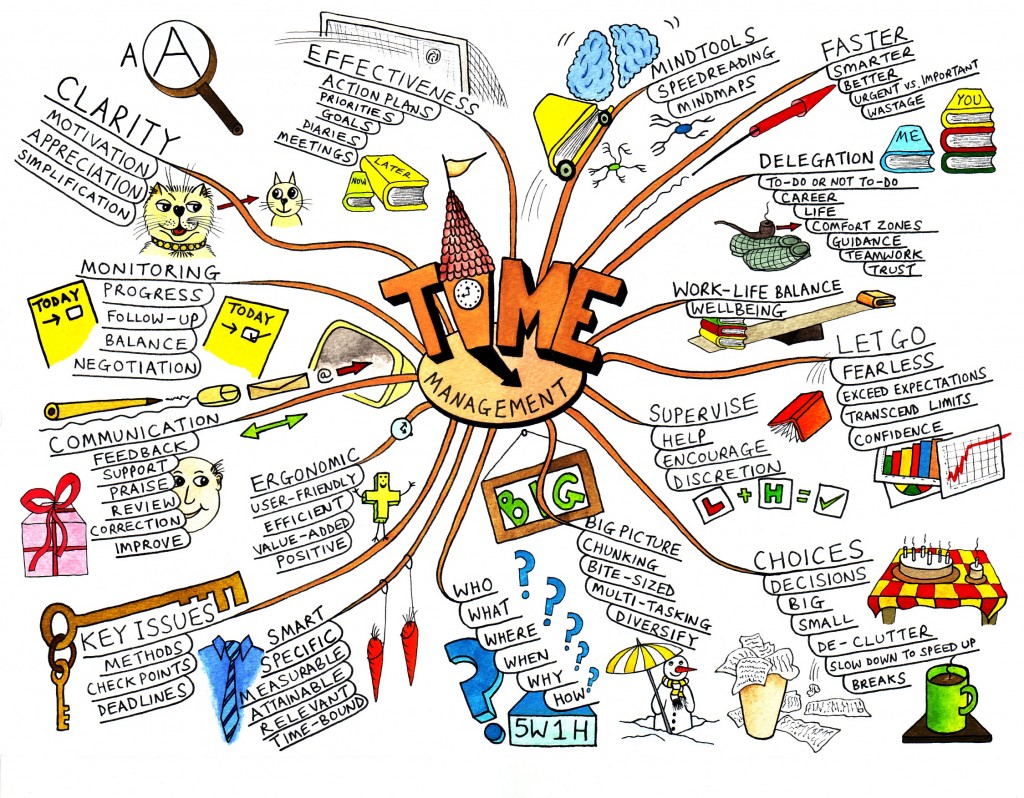
Mind-map example
I personally find the old-school paper to pen, hand drawn scribbled mess that is my hand-writing a much easier method to mind-map. But you can find many online platforms in this modern age that have templates and designs you can start your mind-mapping with. For example: https://imindmap.com/how-to-mind-map/
RESEARCH YOUR TOPIC
Once you have an idea of what you want to do, you have to research more about that idea to fully understand it.
I must stress how important it is to study the topic you choose to represent or explore – you don’t want to be getting important details terribly wrong. You are speaking for or about the issue, and so, as a script-writer, you have a responsibility, and are accountable if you represent a story or issue to an audience without knowing the facts.
I knew I wanted to explore Greek mythology, and so, like any lost sheep, I turned to the internet to research more about mythology.
TED-Ed Youtube Channel: The Tragic myth of Orpheus and Eurydice
Ted-Ed is an amazing Youtube Channel that had provided me with context on multiple Greek mythologies. Now, don’t get me wrong, I’ve learnt about Greek theatre and myths in highschool, but I wanted to present a less known myth to the audience. Tip: try to explore topics that haven’t been covered before.
BUILDING A CHARACTER
An essential element to any play is the characters in them. Who is the protagonist? Antagonist? How did they meet? Why did they meet?
Characters are tricky, and complex things. If your characters are people, then they have to form a sense of realism. The audience has to believe these characters are like humans in order for audiences to empathise with the protagonist’s trials and tribulations.
Of course you have comedic characters, non-human characters, lovers, old people, the list goes on. It really is up to you how you portray your characters. These are a few questions I would have in mind when writing characters:
- Answer the essential, Who, Why, When and How, questions.
- Is there character development? Does the character change or mature through each obstacle?
- What does each obstacle mean symbolically for all the characters?
- How believable are your characters? Are there emotions built on your own experiences, and if so, how would you translate that into the character?
- Have you fleshed out your minor character’s personalities and physicality? Are their stories heard as well?
- What do your characters represent?
- How are you showing conflict between characters? Are you going to contrast characters and their beliefs?
Constantin Stanislavski is a key theatre practitioner in realism. He had created a series of techniques in order for actors to bring believability to the character. His most noticeable technique is ‘Emotion Memory,’ which makes the actor delve into their own emotional experiences and transfer those emotions into the character itself. You can read more about his techniques in his book, Building a Character (1968).
This acting technique, I believe, can also be applied in writing lines and dialogues in scripts. How would you say the line if you were the character? If you were in their situation, how would you feel and act? Sometimes even saying the lines out loud help in creating a sense of realism.
You don’t always have to conform to this standard of creating characters. For example, my play, The Epic Tale of Prometheus, does not have set characters. It was written and staged for an ensemble piece, in other words a group performance that is focused on narrative rather than characterisation. Because of this style, my script and characters were flexible enough to allow the actors themselves to create their own characterisation.
hOW TO START WRITING & building the narrative
Writing can seem a daunting task at first. I find that dividing your script into sections of narrative structure to be super helpful.
The exposition (introduction), rising action, climax, falling action, and dénouement (resolution)
By having sections, you create a focus to your writing. If you set within each section a goal, this ensures that your writing is focused on the narrative and has a progressive build-up in the story-line of events. For example, a story that follows how two best friends become enemies. In the exposition, you would set the characters as best friends at the start. In the rising action section, you could have an event or a misunderstanding to occur that results in the two characters beliefs and values to be contrasted. This acts as the turning point of your narrative, and thus there must be a built up to the next section, the climax. The climax could be the best friend turning into the antagonist, and how this creates direct conflict with the protagonist.
This is just a simple idea, and you can have multiple narrative structures overlapping and embedded within each other. You could even have two separate narratives running alongside each other, and at some points have the sub-narrative cause conflict or a misunderstanding in the main-narrative. This is a key structural theme I’ve noticed Shakespeare use a lot in his plays, like in A Midsummer Nights Dream.
Tip: remember – you have the structure, now go with your gut, write whatever that comes to mind first – vomit verbally on that page – you can always edit, re-edit, re-write, or even scratch the idea and start over again. Don’t write thinking that this is going to be the final version – make mistakes, writing freely takes out the pressure to get it write the first time. You might even find more ideas and authenticity arises from just writing on the spot.

WRITER’S STYLE AND FLAIR
Writing style is the way we express our identities, creativity and individualism. Some people might say that the more confident and sure you are about who you are, the easier it is to translate your style onto paper. But I believe one shouldn’t have to create a style, but rather style is about building on and emphasising the way you already write.
What really sets apart a play from others is the way the script-writer puts in their own flair. What do I mean by this? When script-writers add small, original sections of uniqueness into a script, for example, the use of narrators or a leit-motif in the play, it creates some sort of additional significance to the play. However, when these small sections also reveal the personality of the writer themselves, this then not only adds a different edge to the play, but also a sense of uniqueness that would only come from you, the script-writer.
In my next post, the Part Two of the OAPF, you can learn about how I developed my own writer style and flair through not only script-writing, but also through a directorial approach to my play, The Epic Tale of Prometheus. With an in-depth insight on how I went about staging, rehearsing and creating a technical design, I also share my experience on how to work with actors and the basics of directing. Stay tuned!
All photos, videos, gifs, podcasts and infographics used in this blog are self-produced unless credited otherwise.
 Behind the Curtain